
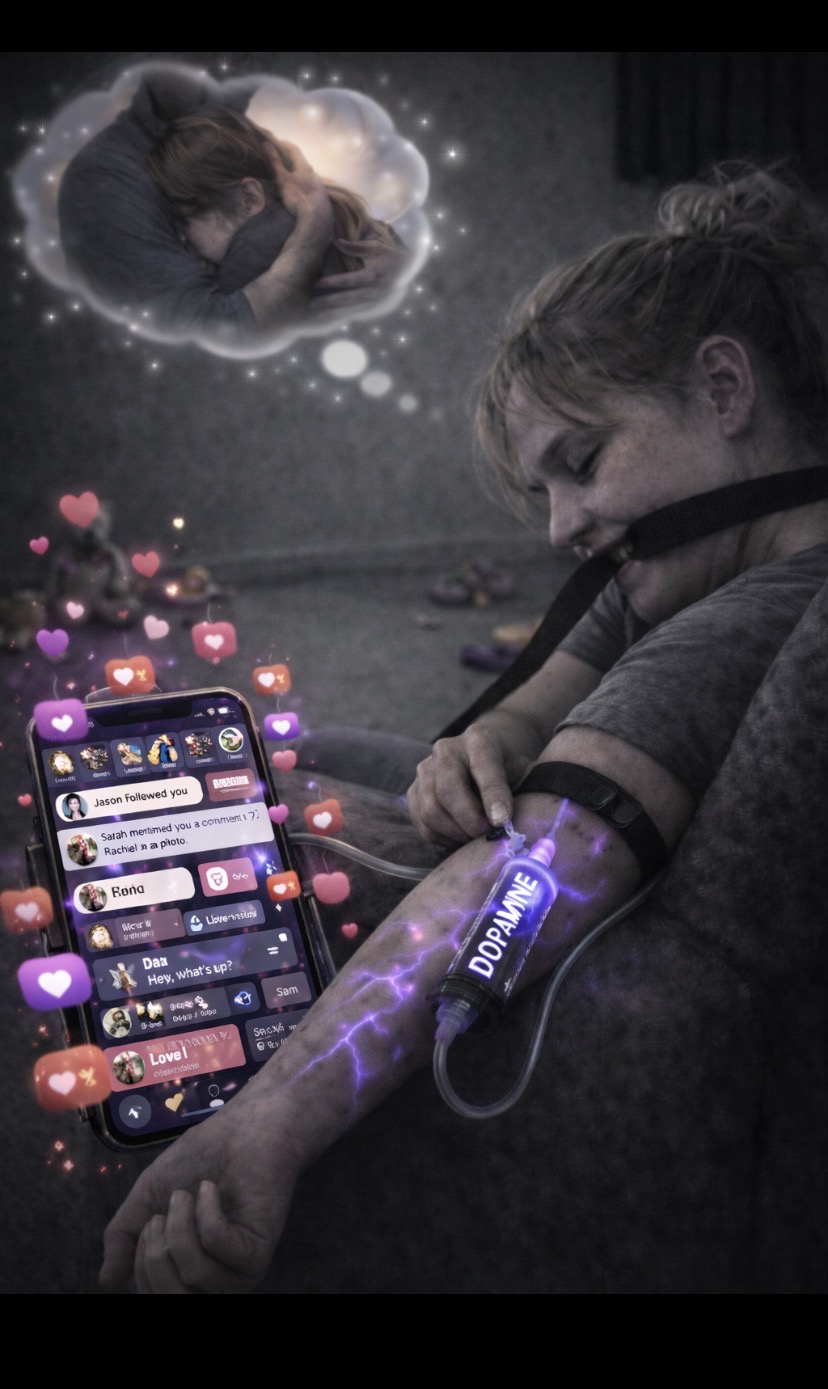
Look closely at this image.
A woman sits alone in a dim room.
A needle runs into her arm labeled dopamine.
But the drug isn’t coming from a syringe on a table.
It’s coming from her phone.
Hearts float up the screen.
Notifications light up.
Someone followed her.
Someone liked her.
Someone noticed her.
And above her head is the thing she actually wants.
Not the phone.
Not the dopamine.
Connection.
Two people holding each other.
Addiction Isn’t Always What We Think
When people hear the word addiction, they often picture drugs, alcohol, or substances. And yes, those can absolutely be addictions.
But addiction is often much quieter than that.
Addiction is anything we repeatedly reach for to regulate our emotions when we don’t know how to soothe ourselves in healthier ways.
Sometimes it’s alcohol.
Sometimes it’s food.
Sometimes it’s work.
And sometimes it’s attention.
A notification.
A message.
A like.
A comment.
A tiny digital heartbeat telling us:
“You matter.”
For a brief moment, our brain releases dopamine — the chemical associated with reward and motivation. We feel a lift. A spark. A hit of relief.
And then it fades.
So we check again.
The Brain Isn’t the Only Thing Involved
Dopamine is neurological.
But addiction isn’t just about the brain.
It’s also about attachment.
Humans are wired for connection. From the moment we’re born, our nervous systems look for safety in other people. Warm arms. Eye contact. Presence. Comfort.
When those early attachment experiences are inconsistent, chaotic, or emotionally unavailable, something subtle happens.
The nervous system learns:
Connection is unpredictable.
But the need for connection doesn’t go away.
So we start searching for it in places that give us small bursts of relief.
Sometimes those bursts come from substances.
Sometimes they come from sex.
Sometimes they come from validation.
Sometimes they come from a glowing screen in our hand.
The Illusion of Connection
Social media, texting, and digital interactions aren’t inherently bad. They can bring people together.
But they can also become dopamine delivery systems.
The brain learns:
Notification = reward.
Attention = safety.
Validation = worth.
But these signals are thin versions of connection.
A heart emoji cannot regulate a nervous system the way presence can.
A comment cannot replace being held.
A notification cannot substitute for feeling known.
So the brain keeps searching.
Scroll.
Refresh.
Check again.
Another small drip of dopamine.
When Addiction and Attachment Collide
This is where things get complicated.
Because often the behavior isn’t really about the dopamine.
It’s about the longing underneath it.
The longing to feel chosen.
Seen.
Important.
Loved.
In therapy, I see this often.
People aren’t addicted to the substance or behavior as much as they are addicted to the momentary relief from feeling alone.
For a second, the ache quiets.
For a second, the nervous system settles.
For a second, it feels like connection.
My Own Reflection
As a therapist, I study these patterns. I talk about them with clients every day.
But I’m also human.
I’ve had moments where I’ve watched myself reach for something — a message, a notification, a response — hoping it would bring relief.
That tiny lift.
That brief feeling of maybe I’m not alone.
And if I’m being honest, that awareness can be uncomfortable.
Because it reminds me that addiction isn’t just something that happens to other people.
It’s something that lives inside our attachment systems, our nervous systems, our need for connection.
And every single human being carries that need.
The Question Isn’t “Why Are You Addicted?”
The real question is:
What is the behavior trying to soothe?
Loneliness?
Rejection?
Fear of abandonment?
Shame?
Most addictive patterns are attempts to regulate pain.
They are coping strategies that developed when healthier forms of comfort weren’t available.
Understanding that doesn’t excuse destructive behaviors.
But it humanizes them.
And sometimes, that compassion is the first step toward change.
The Real Antidote
The opposite of addiction isn’t willpower.
It’s connection.
Real connection.
Being seen.
Being heard.
Being understood.
The kind of connection that doesn’t come from a screen.
The kind that slowly teaches the nervous system:
You’re safe here.
You don’t have to chase dopamine to feel okay.
If this image resonates with you, it may be worth asking yourself a gentle question:
What are you really reaching for?
Because most of the time, beneath the dopamine…
we’re just reaching for each other.